CSP2022-S 题解
T1. 假期计划
Solution
首先,从每个节点开始 bfs 一次,求出任意两个点之间的最少转车次数。
由于路径的形式为 1 \to \mathrm{A} \to \mathrm{B} \to \mathrm{C} \to \mathrm{D} \to 1,考虑枚举路径当中的中转点 \mathrm{B}, \mathrm{C},现在要找出满足条件且权值和最大的一对点 \mathrm{A}, \mathrm{D}。
可以对每个点 x,维护权值前三大的点 g_{x, 1}, g_{x, 2}, g_{x, 3},使得 1 \to g_{x, i} 与 g_{x, i} \to x 之间的最少转车次数 \leq k。至于为什么要维护前三大,是为了不和另外两个中转点重复。
找出满足条件且权值和最大的一对 \mathrm{A}, \mathrm{D},只需枚举 i, j \in [1, 3],分别尝试令 \mathrm{A} = g_{\mathrm{B}, i}, \mathrm{D} = g_{\mathrm{C}, j} 更新答案即可。
时间复杂度 \mathcal{O}(n^2 + nm)。
#include <cstdio>
#include <cstring>
#include <algorithm>
#include <queue>

template <class T>
inline void read(T &x) {
    static char s;
    while (s = getchar(), s < '0' || s > '9');
    x = s - '0';
    while (s = getchar(), s >= '0' && s <= '9') x = x * 10 + s - '0';
}

typedef long long s64;

const int N = 2510, M = 10010;
const int inf = 0x3f3f3f3f;

int n, m, k;
s64 a[N];

int tot, head[N], ver[M * 2], Next[M * 2];
void add_edge(int u, int v) {
    ver[++ tot] = v;    Next[tot] = head[u];    head[u] = tot;
}

int d[N][N];
void bfs(int st) {
    for (int i = 1; i <= n; i ++) d[st][i] = inf;
    d[st][st] = 0;

    std::queue<int> q;
    q.push(st);

    while (q.size()) {
        int u = q.front(); q.pop();

        for (int i = head[u]; i; i = Next[i]) {
            int v = ver[i];
            if (d[st][v] == inf) {
                d[st][v] = d[st][u] + 1;
                q.push(v);
            }
        }
    }
}

bool ok(int i, int j) { return d[i][j] - 1 <= k; }

int g[N][3];
void attend(int x, int y) {
    if (a[g[x][0]] <= a[y]) {
        g[x][2] = g[x][1], g[x][1] = g[x][0], g[x][0] = y;
    } else if (a[g[x][1]] <= a[y]) {
        g[x][2] = g[x][1], g[x][1] = y;
    } else if (a[g[x][2]] < a[y]) {
        g[x][2] = y;
    }
}

s64 ans;
void calc(int p, int q, int x, int y) {
    if (p == y || q == x || x == y || !x || !y) return;
    ans = std::max(ans, a[p] + a[q] + a[x] + a[y]);
}

int main() {
    read(n), read(m), read(k);

    for (int i = 2; i <= n; i ++)
        read(a[i]);

    for (int i = 1, u, v; i <= m; i ++) {
        read(u), read(v);
        add_edge(u, v), add_edge(v, u);
    }

    for (int i = 1; i <= n; i ++) bfs(i);

    for (int i = 2; i <= n; i ++)
        for (int j = 2; j <= n; j ++) {
            if (i == j || !ok(1, j) || !ok(j, i)) continue;
            attend(i, j);
        }

    for (int p = 2; p < n; p ++)
        for (int q = p + 1; q <= n; q ++) {
            if (!ok(p, q)) continue;
            for (int i = 0; i < 3; i ++)
                for (int j = 0; j < 3; j ++)
                    calc(p, q, g[p][i], g[q][j]);
        }

    printf("%lld\n", ans);

    return 0;
}
T2. 策略游戏
Solution
分类讨论(下面说的 最大值 / 最小值 指的是绝对值 最大 / 最小,0 可以同时归进正数和负数):
-
若小 L 选择的 A 为正数:
- 若小 Q 可以选择的 B 只有正数:小 L 会选择正数最大值,小 Q 会选择正数最小值。
- 否则:小 L 会选择正数最小值,小 Q 会选择负数最大值。
-
若小 L 选择的 A 为负数:
- 若小 Q 可以选择的 B 只有负数:小 L 会选择负数最大值,小 Q 会选择负数最小值。
- 否则:小 L 会选择负数最小值,小 Q 会选择正数最大值。
使用两棵线段树分别维护序列 A, B 的区间 正 / 负 最大值 / 最小值 即可。
#include <cstdio>
#include <cstring>
#include <algorithm>

template <class T>
inline void read(T &x) {
    static char s;
    static bool opt;
    while (s = getchar(), (s < '0' || s > '9') && s != '-');
    x = (opt = s == '-') ? 0 : s - '0';
    while (s = getchar(), s >= '0' && s <= '9') x = x * 10 + s - '0';
    if (opt) x = ~x + 1;
}

typedef long long s64;

const int N = 100100;
const int inf = 0x3f3f3f3f;

int n, m, Q;
int a[N], b[N];

struct dat {
    int Pmax, Pmin;
    int Qmax, Qmin;

    dat() { Pmax = -inf, Pmin = inf, Qmax = inf, Qmin = -inf; }

    dat operator + (const dat &rhs) {
        dat self;

        self.Pmax = std::max(Pmax, rhs.Pmax);
        self.Pmin = std::min(Pmin, rhs.Pmin);

        self.Qmax = std::min(Qmax, rhs.Qmax);
        self.Qmin = std::max(Qmin, rhs.Qmin);

        return self;
    }
};

struct SGT {
    struct node {
        int l, r;
        dat h;
    } t[N * 4];

    void build(int p, int l, int r, bool state) {
        t[p].l = l, t[p].r = r;

        if (l == r) {
            int x = state ? b[l] : a[l];

            if (x >= 0) t[p].h.Pmax = t[p].h.Pmin = x;
            if (x <= 0) t[p].h.Qmax = t[p].h.Qmin = x;

            return;
        }

        int mid = (l + r) >> 1;
        build(p * 2, l, mid, state), build(p * 2 + 1, mid + 1, r, state);

        t[p].h = t[p * 2].h + t[p * 2 + 1].h;
    }

    dat ask(int p, int l, int r) {
        if (l <= t[p].l && t[p].r <= r) return t[p].h;

        int mid = (t[p].l + t[p].r) >> 1;

        if (l <= mid && mid < r)
            return ask(p * 2, l, r) + ask(p * 2 + 1, l, r);
        else if (l <= mid)
            return ask(p * 2, l, r);
        else
            return ask(p * 2 + 1, l, r);
    }
} A, B;

int main() {
    read(n), read(m), read(Q);

    for (int i = 1; i <= n; i ++) read(a[i]);
    for (int i = 1; i <= m; i ++) read(b[i]);

    A.build(1, 1, n, 0);
    B.build(1, 1, m, 1);

    while (Q --) {
        int L1, R1, L2, R2;
        read(L1), read(R1), read(L2), read(R2);

        s64 ans = -1e18;

        dat row = A.ask(1, L1, R1), col = B.ask(1, L2, R2);

        if (row.Pmax > -inf) {
            if (col.Qmax == inf)
                ans = std::max(ans, 1ll * row.Pmax * col.Pmin);
            else
                ans = std::max(ans, 1ll * row.Pmin * col.Qmax);
        }

        if (row.Qmax < inf) {
            if (col.Pmax == -inf)
                ans = std::max(ans, 1ll * row.Qmax * col.Qmin);
            else
                ans = std::max(ans, 1ll * row.Qmin * col.Pmax);
        }

        printf("%lld\n", ans);
    }

    return 0;
}
T3. 星战
Solution
反攻时刻条件 1:从任意一个点开始,都可以走入一个环中。
反攻时刻条件 2:每个点的出度均为 1。
显然条件 2 是条件 1 的充分条件。
设集合 S 表示当前时刻每条有向边的起点组成的可重集,则当前时刻为反攻时刻当且仅当 S = \{1, 2, \cdots, n\}。
可以考虑 hash,维护集合 S 所有数的和、平方和。判断 S 的和是否为 \frac{n(n + 1)}{2},S 的平方和是否为 \frac{n(n + 1)(2n + 1)}{6}。
操作 1 与 操作 3,都是往集合 S 里 加 / 删 一个数,直接维护即可。
操作 2 与 操作 4,预处理出每个点的所有入边起点的和、平方和,把原先的贡献删掉,加进新的贡献即可。
时间复杂度 \mathcal{O}(n)。
#include <cstdio>
#include <cstring>
#include <algorithm>
#include <vector>

template <class T>
inline void read(T &x) {
    static char s;
    while (s = getchar(), s < '0' || s > '9');
    x = s - '0';
    while (s = getchar(), s >= '0' && s <= '9') x = x * 10 + s - '0';
}

typedef long long s64;

const int N = 500100;

int n, m, Q;

int tot, head[N], ver[N], Next[N];
void add_edge(int u, int v) {
    ver[++ tot] = v;    Next[tot] = head[u];    head[u] = tot;
}

s64 base1, base2;

s64 all1, all2;

s64 sum1[N], sum2[N];
s64 cur1[N], cur2[N];

int main() {
    read(n), read(m);

    for (int i = 1, u, v; i <= m; i ++) {
        read(u), read(v);
        add_edge(v, u);
    }

    base1 = 1ll * n * (n + 1) / 2;
    base2 = 1ll * n * (n + 1) * (2 * n + 1) / 6;

    for (int v = 1; v <= n; v ++)
        for (int i = head[v]; i; i = Next[i]) {
            int u = ver[i];
            sum1[v] += u, sum2[v] += 1ll * u * u;
        }

    for (int i = 1; i <= n; i ++)
        cur1[i] = sum1[i], cur2[i] = sum2[i];

    for (int i = 1; i <= n; i ++)
        all1 += sum1[i], all2 += sum2[i];

    read(Q);

    while (Q --) {
        int opt, u, v;
        read(opt), read(u);

        if (opt == 1) {
            read(v);
            cur1[v] -= u, cur2[v] -= 1ll * u * u;
            all1 -= u, all2 -= 1ll * u * u;
        } else if (opt == 2) {
            all1 -= cur1[u], cur1[u] = 0;
            all2 -= cur2[u], cur2[u] = 0;
        } else if (opt == 3) {
            read(v);
            cur1[v] += u, cur2[v] += 1ll * u * u;
            all1 += u, all2 += 1ll * u * u;
        } else {
            all1 -= cur1[u], cur1[u] = sum1[u], all1 += sum1[u];
            all2 -= cur2[u], cur2[u] = sum2[u], all2 += sum2[u];
        }

        puts(all1 == base1 && all2 == base2 ? "YES" : "NO");
    }

    return 0;
}
T4. 数据传输
Solution
先讨论 k = 3 的情况。
对于每个从 s 到 t 的询问,不妨以 t 为根,将从 s 到 t 的路径提取出来。设从 s 到 t 的路径上的第 i 个点为 \mathrm{seq}_i。
从 s 到 t 的过程中,有四种走法:
- 转移 1:向 t 的方向走 1 步。
- 转移 2:向 t 的方向走 2 步。
- 转移 3:向 t 的方向走 3 步。
- 转移 4:向 t 的方向走 2 步,再向它的某个儿子走 1 步。
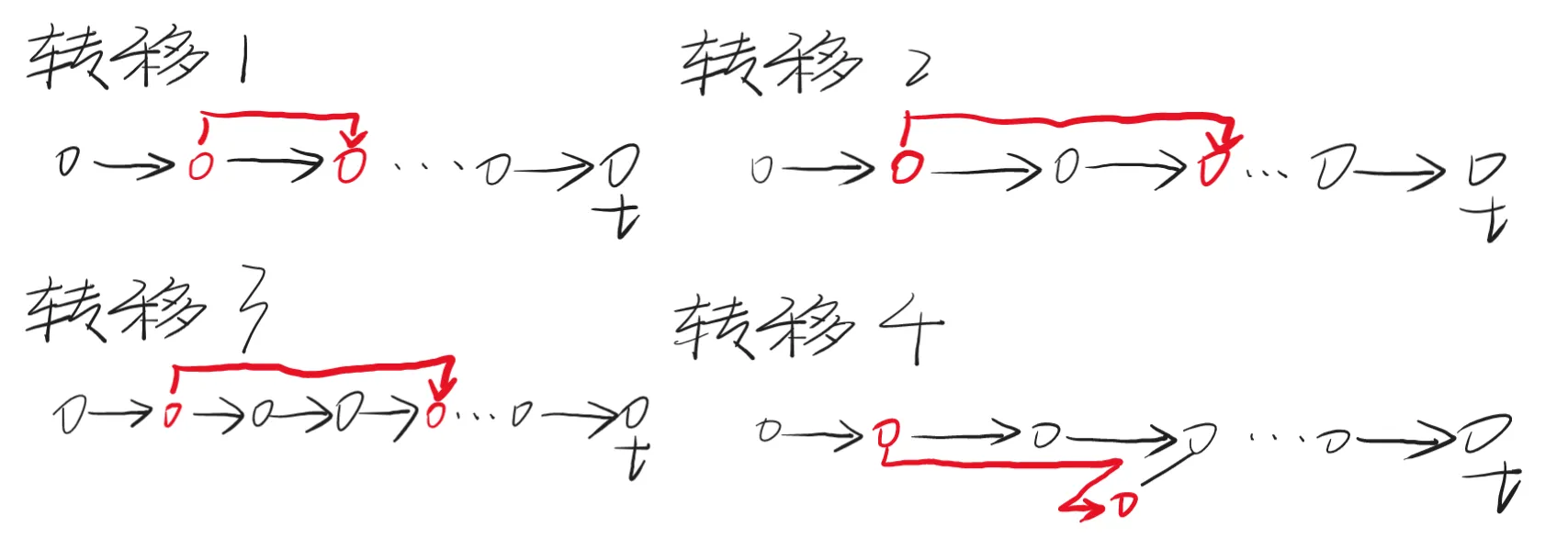
至于为什么不能从当前点向 t 的方向走 1 步,再向它的子树内走 2 步。这是因为使用这种转移后的下一步转移,被从当前点出发的所有下一步转移包含,而这种转移多走了一个点,显然是更劣的。
注意到在转移 4 中,向 t 的方向走 2 步,再向它的某个儿子走 1 步,则走向的这个儿子的权值要尽量小。故记录 \mathrm{great}_u 表示 u 的点权最小的出点的权值,即 \min\limits_{(u, v) \in E} \{a_v\}。
设 f_{i, 0 / 1 / 2} 分别表示到从起点 s 出发,与 \mathrm{seq}_i 距离为 0 / 1 / 2 的点的代价和最小值,则:
注意到这个转移可以看成是(这里的矩阵乘法是 \min, + 广义矩阵乘法):
考虑动态 dp。有两种写法:
- 运用树上倍增自下而上地维护矩阵积。回答询问时,将 s \to \mathrm{LCA}(s, t) 的链信息与 t \to \mathrm{LCA}(s, t) 的链信息分别求出来,分类讨论合并信息。
- 运用树上倍增自下而上、自上而下地维护矩阵积。回答询问时,将 s \to \mathrm{LCA}(s, t) 的链信息与 \mathrm{LCA}(s, t) \to t 的链信息分别求出来,合并信息。
至于 k = 1, 2 的情况就很简单了,这里留给读者。
时间复杂度 \mathcal{O}(nk^3 \log n)。
#include <cstdio>
#include <cstring>
#include <algorithm>

template <class T>
inline void read(T &x) {
    static char s;
    while (s = getchar(), s < '0' || s > '9');
    x = s - '0';
    while (s = getchar(), s >= '0' && s <= '9') x = x * 10 + s - '0';
}

template <class P, class Q>
void relax(P &x, const Q &y) {
    if (x > y) x = y;
}

typedef long long s64;

const int N = 200100;
const s64 inf = 1e18;

int n, Q, k;

int a[N];
int great_son[N];

int tot, head[N], ver[N * 2], Next[N * 2];
void add_edge(int u, int v) {
    ver[++ tot] = v;    Next[tot] = head[u];    head[u] = tot;
}

struct mat {
    s64 num[3][3];

    mat() { memset(num, 0x3f, sizeof(num)); }

    void init(int u, int v) {
        if (k == 1) {
            num[0][0] = a[u];
        } else if (k == 2) {
            num[0][0] = a[u], num[0][1] = 0;
            num[1][0] = a[u], num[1][1] = inf;
        } else {
            num[0][0] = a[u], num[0][1] = 0, num[0][2] = inf;
            num[1][0] = a[u], num[1][1] = great_son[u], num[1][2] = 0;
            num[2][0] = a[u], num[2][1] = inf, num[2][2] = great_son[v];
        }
    }

    mat operator * (const mat &rhs) const {
        mat self;
        for (int i = 0; i < k; i ++)
            for (int j = 0; j < k; j ++)
                for (int p = 0; p < k; p ++)
                    relax(self.num[i][j], num[i][p] + rhs.num[p][j]);
        return self;
    }
};

struct vec {
    s64 num[3];

    vec() { memset(num, 0x3f, sizeof(num)); }
    vec(int x) { num[0] = x; num[1] = num[2] = inf; }

    vec operator * (const mat &rhs) const {
        vec self;
        for (int j = 0; j < k; j ++)
            for (int p = 0; p < k; p ++)
                relax(self.num[j], num[p] + rhs.num[p][j]);
        return self;
    }
};

int Fa[N];

int dep[N];

int anc[18][N];
mat f[18][N];

void dfs(int u) {
    dep[u] = dep[Fa[u]] + 1;

    great_son[u] = 0x3f3f3f3f;
    for (int i = head[u]; i; i = Next[i]) {
        int v = ver[i];
        if (v == Fa[u]) continue;

        relax(great_son[u], a[v]);
    }

    if (Fa[u]) {
        anc[0][u] = Fa[u], f[0][u].init(Fa[u], u);
        for (int i = 1; i <= 17; i ++) {
            anc[i][u] = anc[i - 1][anc[i - 1][u]]; if (!anc[i][u]) break;
            f[i][u] = f[i - 1][u] * f[i - 1][anc[i - 1][u]];
        }
    }

    for (int i = head[u]; i; i = Next[i]) {
        int v = ver[i];
        if (v == Fa[u]) continue;

        Fa[v] = u;
        dfs(v);
    }
}

int lca(int x, int y) {
    if (dep[x] > dep[y]) std::swap(x, y);
    for (int i = 17; i >= 0; i --)
        if (dep[x] <= dep[anc[i][y]]) y = anc[i][y];
    if (x == y) return x;
    for (int i = 17; i >= 0; i --)
        if (anc[i][x] != anc[i][y]) x = anc[i][x], y = anc[i][y];
    return anc[0][x];
}

vec calc(int x, int up) {
    vec v = vec(a[x]);
    for (int i = 17; i >= 0; i --)
        if (up >> i & 1) v = v * f[i][x], x = anc[i][x];
    return v;
}

int main() {

    read(n), read(Q), read(k);

    a[0] = 0x3f3f3f3f;
    for (int i = 1; i <= n; i ++) read(a[i]);

    for (int i = 1, u, v; i < n; i ++) {
        read(u), read(v);
        add_edge(u, v), add_edge(v, u);
    }

    dfs(1);

    while (Q --) {
        int x, y, z;
        read(x), read(y), z = lca(x, y);

        if (k == 1) {
            if (y == z) { printf("%lld\n", calc(x, dep[x] - dep[y]).num[0]); continue; }
            if (x == z) { printf("%lld\n", calc(y, dep[y] - dep[x]).num[0]); continue; }

            printf("%lld\n", calc(x, dep[x] - dep[z] - 1).num[0] + calc(y, dep[y] - dep[z] - 1).num[0] + a[z]);
        } else if (k == 2) {
            if (y == z) { printf("%lld\n", calc(x, dep[x] - dep[y]).num[0]); continue; }
            if (x == z) { printf("%lld\n", calc(y, dep[y] - dep[x]).num[0]); continue; }

            vec dx = calc(x, dep[x] - dep[z] - 1), dy = calc(y, dep[y] - dep[z] - 1);

            s64 ans = inf;
            relax(ans, std::min(dx.num[0], dx.num[1]) + std::min(dy.num[0], dy.num[1]) + a[z]);
            relax(ans, dx.num[0] + dy.num[0]);

            printf("%lld\n", ans);
        } else {
            if (y == z) { printf("%lld\n", calc(x, dep[x] - dep[y]).num[0]); continue; }
            if (x == z) { printf("%lld\n", calc(y, dep[y] - dep[x]).num[0]); continue; }

            vec dx = calc(x, dep[x] - dep[z] - 1), dy = calc(y, dep[y] - dep[z] - 1);

            s64 tx = inf, ty = inf;
            relax(tx, dx.num[0]), relax(tx, dx.num[1]), relax(tx, dx.num[2]);
            relax(ty, dy.num[0]), relax(ty, dy.num[1]), relax(ty, dy.num[2]);

            s64 ans = inf;
            relax(ans, tx + ty + a[z]);
            relax(ans, dx.num[0] + dy.num[0]);
            relax(ans, dx.num[1] + dy.num[0]);
            relax(ans, dx.num[0] + dy.num[1]);
            relax(ans, dx.num[1] + dy.num[1] + std::min(great_son[z], a[Fa[z]]));

            printf("%lld\n", ans);
        }
    }

    return 0;
}
#include <cstdio>
#include <cstring>
#include <algorithm>
template <class T>
inline void read(T &x) {
static char s;
while (s = getchar(), s < '0' || s > '9');
x = s - '0';
while (s = getchar(), s >= '0' && s <= '9') x = x * 10 + s - '0';
}
void relax(int &x, const int &y) {
if (x > y) x = y;
}
typedef long long s64;
const int N = 200100;
const s64 inf = 1e18;
int n, Q, k;
int a[N], great[N];
int tot, head[N], ver[N * 2], Next[N * 2];
void add_edge(int u, int v) {
ver[++ tot] = v; Next[tot] = head[u]; head[u] = tot;
}
struct mat {
int r, c;
s64 num[3][3];
mat() {}
mat(int _r, int _c) {
r = _r, c = _c;
for (int i = 0; i < r; i ++)
for (int j = 0; j < c; j ++)
num[i][j] = inf;
}
void init(int u, int pre) {
r = c = k;
if (k == 1) {
num[0][0] = a[u];
} else if (k == 2) {
num[0][0] = a[u], num[0][1] = 0;
num[1][0] = a[u], num[1][1] = inf;
} else {
num[0][0] = a[u], num[0][1] = 0, num[0][2] = inf;
num[1][0] = a[u], num[1][1] = great[u], num[1][2] = 0;
num[2][0] = a[u], num[2][1] = inf, num[2][2] = great[pre];
}
}
mat operator * (const mat &rhs) const {
mat cur(r, rhs.c);
for (int i = 0; i < r; i ++)
for (int j = 0; j < rhs.c; j ++)
for (int p = 0; p < c; p ++)
cur.num[i][j] = std::min(cur.num[i][j], num[i][p] + rhs.num[p][j]);
return cur;
}
};
mat up[18][N], dn[18][N];
int dep[N];
int anc[18][N];
void dfs(int u, int fu) {
dep[u] = dep[fu] + 1;
anc[0][u] = fu;
for (int i = 1; i <= 17; i ++) anc[i][u] = anc[i - 1][anc[i - 1][u]];
for (int i = head[u]; i; i = Next[i]) {
int v = ver[i];
if (v == fu) continue;
up[0][v].init(u, v), dn[0][v].init(v, u);
dfs(v, u);
}
}
int lca(int x, int y) {
if (dep[x] > dep[y]) std::swap(x, y);
for (int i = 17; i >= 0; i --)
if (dep[x] <= dep[y] - (1 << i)) y = anc[i][y];
if (x == y) return x;
for (int i = 17; i >= 0; i --)
if (anc[i][x] ^ anc[i][y]) x = anc[i][x], y = anc[i][y];
return anc[0][x];
}
void calc_up(int x, int k, mat &cur) {
for (int i = 17; i >= 0; i --)
if (k >> i & 1) cur = cur * up[i][x], x = anc[i][x];
}
void calc_dn(int x, int k, mat &cur) {
static int seq[18];
for (int i = 0; i <= 17; i ++)
if (k >> i & 1) seq[i] = x, x = anc[i][x];
for (int i = 17; i >= 0; i --)
if (k >> i & 1) cur = cur * dn[i][seq[i]];
}
int main() {
read(n), read(Q), read(k);
for (int i = 1; i <= n; i ++)
read(a[i]);
for (int i = 1; i <= n; i ++) great[i] = 0x3f3f3f3f;
for (int i = 1, u, v; i < n; i ++) {
read(u), read(v);
add_edge(u, v), add_edge(v, u);
relax(great[u], a[v]);
relax(great[v], a[u]);
}
dfs(1, 0);
for (int j = 1; j <= 17; j ++)
for (int i = 1; i <= n; i ++)
up[j][i] = up[j - 1][i] * up[j - 1][anc[j - 1][i]],
dn[j][i] = dn[j - 1][anc[j - 1][i]] * dn[j - 1][i];
while (Q --) {
int x, y, z;
read(x), read(y), z = lca(x, y);
mat cur(1, k);
cur.num[0][0] = a[x], cur.num[0][1] = cur.num[0][2] = inf;
calc_up(x, dep[x] - dep[z], cur);
calc_dn(y, dep[y] - dep[z], cur);
printf("%lld\n", cur.num[0][0]);
}
return 0;
}